
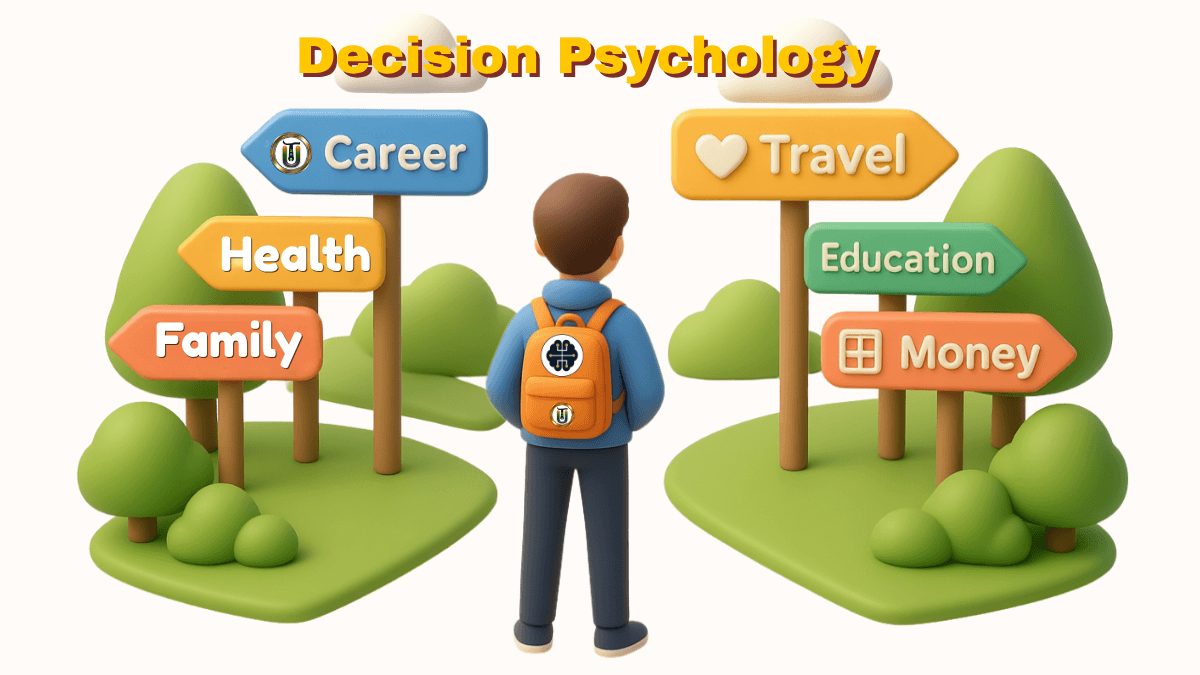
Life is a series of human decision making. To start any action decision is required. Some decisions May simple. Some decisions may with complexity. The whole day comprises several decisions. Generally you don’t notice them. You decide what needs to be prioritized. You decides what have to ignore. You decide the action taken and its approach. Your results are being shaped by your choices.
It is the believe of most people that decisions comes due to intelligence. But this is not always true. Clear process required outcome of good decision. decision psychology studies this process. Its focus on process of decision making. Outcomes influenced by clarity, structure and context.
Our focus is on practical decision making practice in this article. It will help you to implement decision psychology in real life.
Example:- Assume that same circumstances are being faced by two individuals. One is reacting quickly. The other follows a process. After some time, their results are different. The difference is not luck. It is the quality of decision-making.
What is decision Psychology (Decision process)?
Decision Psychology is the study about how our decisions are structured and executed. It is focused on:
How choices are framed, How options are evaluated and How outcomes are predicted.
It’s not all about cognition (thinking). It is about how thinking is applied.
A decision contains three important elements as following:-
- Input
- Process
- Output
- Input:- The Information You collected.
- Process:- How you analyze that information
- Output:- Final choice by you.
If any part is weak, the decision quality reduces.
Example:- If your input is incomplete, even good thinking will fail.
Your choices may be wrong and random if your process is not clear.
Decision Psychology can help to improve all these three elements.
What is the Requirement of decision Psychology?
Life in contemporary society has complicated decisions. You faces, More options, More information and More pressure. Without any structured or well planed approach, decisions may become stressful.
People may Delay decisions, Make inconsistent choices and Depend on others. By reducing confusions, Decision Psychology provides a structure. It increases clarity.
decision psychology is important in Career planning, Financial decisions, Business strategies and Daily problem solving etc.
Example:- An individual is choosing his profession without any plan/structure. That person may switch hist career multiple times. Another individual following a decision-making framework and making a wise selection. He will grow up with a steady pace.
The difference is method.
How to improve decisions (human decision making skills)?
Decision Psychology isn’t just for experts or researchers. You can actually use it in your day-to-day life with some simple frameworks.
These frameworks of decision psychology are as below:-
- Define your decision clearly.
- Set a clear criteria.
- Use 10-10-10 Rule.
- Adopt an opportunity cost mindset.
- Limit your options.
- Use reversible vs irreversible decisions.
- Set decision deadline.
1. Define your decision clearly:-
Do not start without any clarity. Write down your decision in one sentence.
Example:-Instead of What should I do?, Write Should I have to change my job this year?
Thinking can be improve by clarity.
2. Set clear criteria:-
You have to decide that what matters most. A common criteria includes cost, time, risk, Long-term value etc.
Example:- If career growth is your priority,then salary should not be the only factor for consideration.
3. Use 10-10-10 Rule:-
Think about outcomes in: 10-minutes, 10-months and 10-years. Your long term thinking can be improved by this method.
4. Adopt an opportunity cost mindset:-
Every decision has a cost. When you choose one option, you lose another one.
Example:- You lose the time of skill development if you choose entaetainment.
5. Limit Your Options:-
Your clarity may be reduced by too many options. Shortlist only the best few. Example:- Set top 3 courses and compare them instead of 20 courses.
6. Use reversible vs irreversible decisions:-
Not all decisions are equal. Reversible decisions can be changed. Irreversible decisions need deep thinking.
Example:- You are buying a book is a reversible decision. It is not easy to revers your choosen career.
7. Set a decision deadline:-
Delay in decision reduces its effectiveness. Set time limit to every decision.
Example:- I will decide that how to do this work within 3 days. This improves action.
Major types of Decision Psychology (Top 5+)
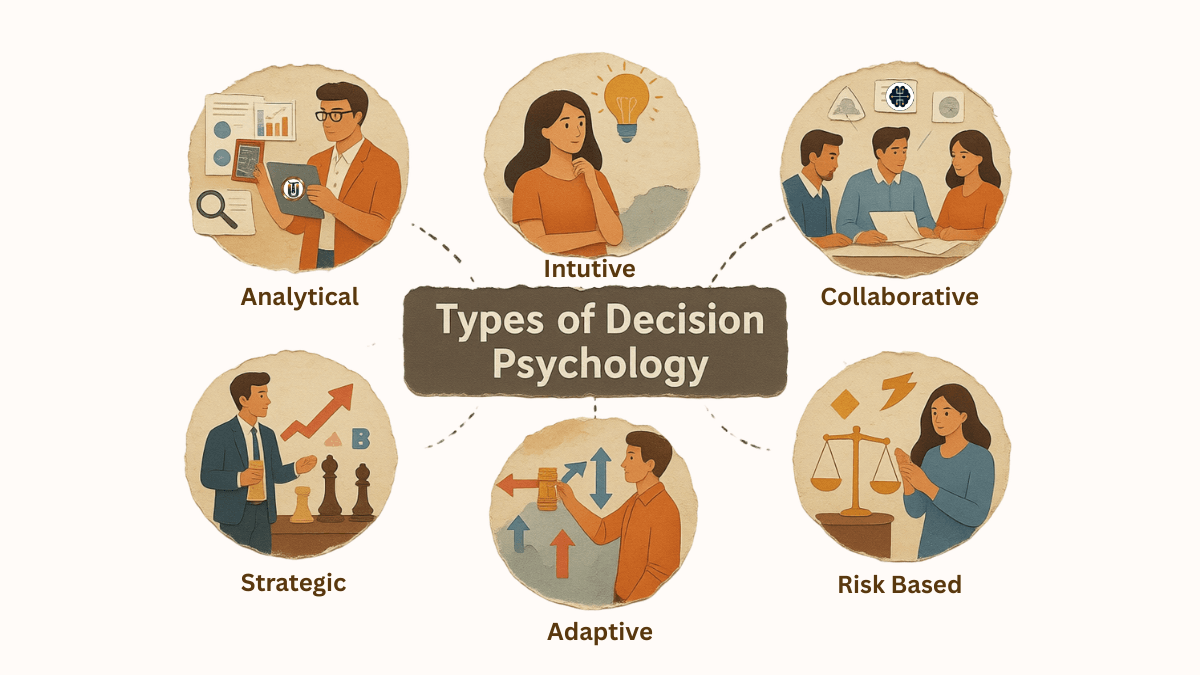
Everyone has their own way of deciding things, and sometimes different situations call for different styles. Top 5+ major types of decision psychology are:-
- Analytical decision making.
- Intuitive decision making.
- Strategic decision making.
- Adaptive decision making.
- Collaborative decision making.
- Risk based decision making.
- Time based decision making.
- Value based decision making.
1. Analytical decision making
This approach uses logics and data for good decision. Steps include for this:-
- Collect information
- Compare options
- Evaluate outcomes
Example:- Before production and launching of any product, a business owner compares profit margins.
2. Intuitive decision making
This approach uses experience. It is fast. It works well in situations that are familiar.
Example:- Experienced manager can concludes problems without detailed analysis. His experience helps to make decision.
3. Strategic decision making
This focuses the long term impact. Future goals are aligned with decision.
Example:- Choose skill development over short term income. This may build long term success.
4. Adaptive decision making
In this approach adjustment is changes based. It is flexible.
Example:- A company shifts its ad campaign when it sees market trends changing.
5. Collaborative decision making
It involves the contribution of the group for a decision. This improves the perspective.
Example:- Any team/group discusses various options before finalizing a plan. This reduces the scope for shortcomings.
6. Risk based decision making
It is focused on risk assessment. A balance between risk and return is established by Risk based decision making.
Example:- An investor divides money into safe and risky assets. This controls his loss.
7. Time based decision making
Time based decision making totaly depends on the urgency. Some decisions needs speed to decide quickly. Some decisions needs patience.
Example:- Emergency decisions like calling ambulance on accident are quick. Strategic decisions are time taking.
8. Value based decision making
Personal values are aligned with value based decision making.
Example:- A person chooses ethical work over high-paying unethical work.
This creates long term satisfaction.
Key Takeaways
Using decision psychology means focusing on how you decide, not just what you decide. Clear structures can improve your decisions.
Defining criteria increases clarity. Limiting options reduces confusion. Long term thinking can improve outcomes. Different situations needs different decisions /structures.
Conclusion
Decision psychology is not about making perfect decision. It is about making better choices consistently.
You cannot control every outcome by yourself. You can control your processes. A strong process leads to better results over the time. Whenever you define your decisions clearly, set criteria, and follow structured thinking, you reduce mistakes.
You gain confidence by adopting these psychology elements. Better decisions do not comes from the luck. They comes from the clarity and your discipline.
Frequently Asked Questions About decision Psychology
What is decision psychology?
It is the study of how decisions are structured and made.
How can I improve my decisions?
Use clear frameworks, define criteria, and limit options.
What is the most important step in decision making?
Defining the decision clearly.
Are fast decisions bad?
Not always. They are useful in simple or familiar situations.
Why do people delay decisions?
Due to confusion, fear, or lack of structure.
How does environment affect decision making?
Environment influences decisions through noise, time pressure, and available information. A clear and calm environment improves decision quality.
What is structured decision making?
Structured decision making is a method where decisions follow a clear process with defined steps, criteria, and evaluation methods.
Why do people struggle with decision making?
People struggle due to too many options, lack of clarity, fear of wrong outcomes, and absence of a proper decision process.
What is the role of experience in decision psychology?
Experience helps in faster and more accurate decisions, especially in familiar situations.
How can decision-making be improved in daily life?
It can be improved by setting clear goals, limiting options, using decision frameworks, and reviewing past decisions.
What is decision paralysis?
Decision paralysis is a condition where a person is unable to decide due to too many choices or fear of making the wrong decision.
How does time pressure affect decisions?
Time pressure forces quick decisions, which may reduce accuracy and increase errors.
What is long-term vs short-term decision making?
Short-term decisions focus on immediate results, while long-term decisions focus on future impact and sustainability.
Can decision-making be taught or learned?
Yes. Decision-making is a skill that improves with practice, awareness, and structured methods.
What is the importance of reviewing decisions?
Reviewing helps identify mistakes, learn from outcomes, and improve future decisions.
How do priorities affect decision making?
Clear priorities help in choosing the most important option and avoiding confusion.
What is the difference between choice and decision?
A choice is selecting an option, while a decision involves analysis, judgment, and commitment to that choice.
How does information overload impact decisions?
Too much information creates confusion, delays decisions, and reduces clarity.
What is practical decision psychology?
It focuses on applying decision-making methods in real-life situations to improve outcomes.
How can I suggest/provide feedback on this article?
You can reach us by filling out our contact us form.