
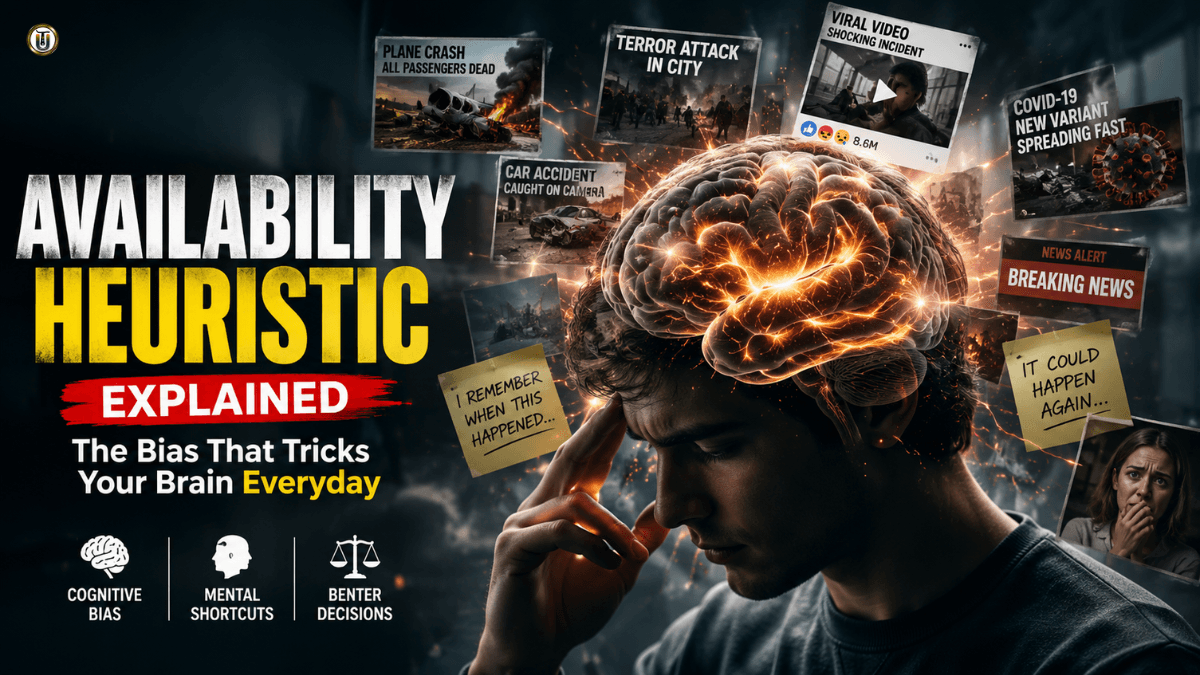
Have you ever felt afraid of flying after seeing a plane crash on the news, even though road accidents are far more common? Or maybe you believed crime was increasing simply because social media constantly showed violent stories.
This is called the availability heuristic.
The availability heuristic is a mental shortcut where people judge the likelihood of events based on how easily examples come to mind. The more vivid, emotional, or recent something feels, the more important or common it appears.
This cognitive bias affects daily decisions, financial choices, relationships, health concerns, and even political opinions. At Universal Thrill, we explore how hidden psychological patterns shape human behavior and decision making.
Understanding this bias can help you think more clearly, reduce emotional reactions, and make better decisions.
- What Is the Availability Heuristic?
- How the Availability Heuristic Works
- 7 Powerful Availability Heuristic Examples
- Why the Availability Heuristic Happens
- The Psychological Impact of Availability Bias
- Availability Heuristic vs Reality
- How to Overcome the Availability Heuristic
- Why Understanding Cognitive Bias Matters
- Conclusion
- FAQ Section
What Is the Availability Heuristic?
The availability heuristic is a psychological concept introduced by Daniel Kahneman and Amos Tversky.
It describes how the brain estimates probability using immediately available memories instead of actual statistics.
In simple words:
- Easy-to-remember events feel more common
- Emotional memories feel more important
- Recent experiences strongly influence judgment
The brain prefers speed over accuracy. Instead of deeply analyzing information, it relies on mental shortcuts called heuristics.
Sometimes this helps. Often, it creates thinking errors.
How the Availability Heuristic Works
The brain stores emotionally intense or repeated information more strongly.
Because of this:
- News headlines feel more common than reality
- Dramatic events seem frequent
- Personal experiences overpower data
- Fear-based memories influence future choices
For example:
If someone watches multiple reports about shark attacks, they may suddenly fear swimming in the ocean. In reality, shark attacks are extremely rare.
The mind confuses “easy to remember” with “likely to happen.”
That is the core of the availability heuristic.
7 Powerful Availability Heuristic Examples
1. Fear of Flying
After seeing airplane crashes on television, many people avoid flights.
However, statistically, flying is much safer than driving.
The emotional impact of aviation disasters makes them highly memorable, which distorts risk perception.
2. Health Anxiety After Reading Symptoms
People often believe they have serious illnesses after reading online medical content.
Because disease stories are emotionally strong and easy to recall, the brain overestimates danger.
This is common in anxiety-driven thinking.
3. Crime Perception From Social Media
Constant exposure to crime videos can create the illusion that society is becoming extremely dangerous.
In reality, crime rates may remain stable or even decline.
Repeated exposure changes perception.
4. Stock Market Panic
Investors often panic during market crashes because recent losses dominate memory.
This causes emotional decision making instead of rational investing.
Availability bias plays a major role in financial behavior.
5. Relationship Trust Issues
If someone experienced betrayal in the past, they may assume future relationships will also fail.
Past emotional memories become mentally available and influence present judgment.
6. Product Reviews and Buying Decisions
One viral negative review can discourage thousands of buyers.
Even if millions of people had positive experiences, the emotional negative story becomes easier to remember.
7. Fear After Watching Movies
Horror films or crime documentaries can temporarily change behavior.
A person may avoid dark streets or become overly suspicious because emotional imagery stays active in memory.
Why the Availability Heuristic Happens
The brain is designed to save energy.
Analyzing every situation logically would require enormous mental effort. Instead, the mind uses shortcuts for fast decision making.
The availability heuristic becomes stronger when information is:
- Emotional
- Recent
- Repeated frequently
- Personally experienced
- Visually dramatic
Modern media amplifies this problem.
Social media platforms prioritize emotional content because it increases engagement. As a result, shocking stories become mentally dominant.
People begin to mistake visibility for truth.
The Psychological Impact of Availability Bias
The availability heuristic influences many areas of life:
Emotional Reactions
People become more fearful, anxious, or reactive because emotionally available memories dominate thinking.
Poor Financial Decisions
Investors may sell assets too quickly after hearing negative market news.
Political Polarization
Repeated exposure to extreme stories can distort public perception.
Increased Stress
Continuous exposure to alarming information keeps the brain in a state of alertness.
Relationship Problems
Past negative experiences can unfairly shape expectations about people.
Availability Heuristic vs Reality
One important lesson in psychology is this:
What feels true is not always true.
The human brain is emotional before it is logical.
The availability heuristic creates mental distortions because feelings and memories often overpower evidence.
For example:
- Rare dangers feel common
- Common risks feel invisible
- Emotional stories dominate statistics
- Recent events appear more important than long-term patterns
Understanding this difference improves mental clarity and decision making.
How to Overcome the Availability Heuristic
1. Pause Before Reacting
Emotional reactions often come from immediately available memories.
Take time before making important decisions.
2. Look at Data
Statistics provide a more accurate picture than emotional stories.
Always compare feelings with evidence.
3. Reduce Fear-Based Media Consumption
Constant exposure to sensational content increases cognitive bias.
Limit emotionally manipulative media.
4. Ask Logical Questions
Try asking:
- Is this event actually common?
- Am I reacting emotionally?
- What evidence supports this belief?
5. Expand Your Information Sources
Different perspectives reduce mental distortions.
Balanced information improves critical thinking.
Why Understanding Cognitive Bias Matters
Most people believe their decisions are rational.
However, psychology shows that human thinking is deeply influenced by unconscious biases.
The availability heuristic affects:
- Buying behavior
- Social opinions
- Fear responses
- Career decisions
- Relationships
- Health anxiety
Learning about cognitive biases improves self-awareness.
It helps people separate emotional impressions from objective reality.
This creates better judgment, calmer thinking, and smarter decisions.
Conclusion
The availability heuristic is one of the most powerful cognitive biases in psychology. It causes people to judge reality based on what is easiest to remember instead of what is statistically accurate.
Emotional experiences, dramatic news, and repeated exposure strongly shape perception.
By recognizing this thinking error, people can improve decision making, reduce anxiety, and develop clearer judgment.
At Universal Thrill — “Where Curiosity Meets Clarity” — understanding psychology is not just about knowledge. It is about learning how the mind quietly shapes everyday life.
FAQ Section
What is the availability heuristic in simple words?
The availability heuristic is a mental shortcut where people judge how common something is based on how easily examples come to mind.
What is an example of availability heuristic?
Fear of flying after seeing airplane crash news is a common example of availability bias.
Is availability heuristic a cognitive bias?
Yes. It is a cognitive bias that affects judgment and decision making.
How does social media increase availability bias?
Social media repeatedly shows emotional and dramatic content, making certain events feel more common than they actually are.
Who discovered the availability heuristic?
Psychologists Daniel Kahneman and Amos Tversky introduced the concept.
How can I suggest/provide feedback on this article?
You can reach us by filling out our contact us form.