
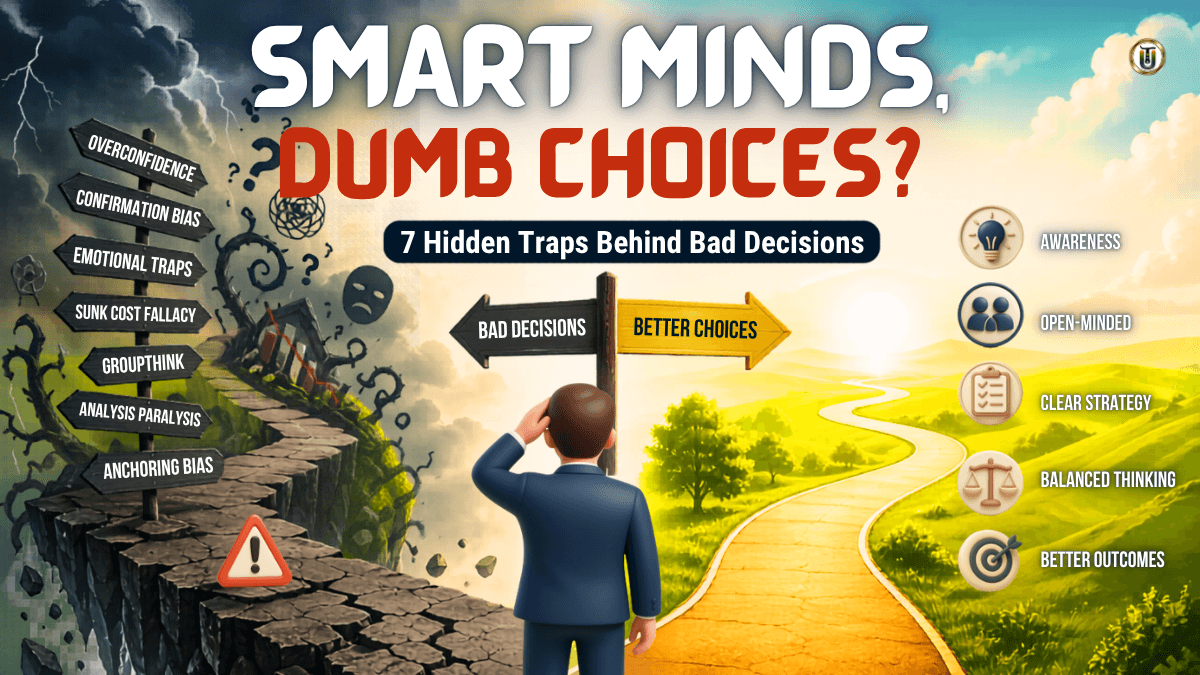
Why Smart People Make Bad Decisions? have you ever think about this? Smart people solve complex problems. They perform well in academics and careers. Intelligence is often linked with success. However, being smart does not guarantee good decisions.
This may seem surprising. But intelligence alone does not ensure good judgment.
Many highly intelligent individuals make poor choices. These mistakes happen in business, relationships, and daily life. The reason is simple.
Decision-making depends on emotions, habits, and mental patterns. These patterns can mislead even the smartest minds.
This article explains the key reasons behind such mistakes. It also offers practical ways to improve choices.
- Understanding Decision Psychology
- 7 Hidden Traps That Lead to Poor Decisions
- Common Patterns Behind Decision Errors
- Conclusion
- FAQ (Frequently Asked Questions About Why Smart People Make Bad Decisions)
- Why Smart People Make Bad Decisions?
- What are cognitive biases in decisions?
- Is overconfidence common in intelligent people?
- What is confirmation bias?
- How does emotion affect decisions?
- What is analysis paralysis?
- Can decision-making improve with practice?
- What is sunk cost fallacy?
- How can groupthink be avoided?
- Are simple decisions better than complex ones?
- Why Intelligence Is Not Enough
- How can I suggest/provide feedback on this article?
- Sources and References
Understanding Decision Psychology
Decision psychology studies how people choose between options. It shows that humans are not always rational. Instead, they rely on mental shortcuts. Even intelligent individuals rely on mental shortcuts. These shortcuts are useful. But they can also lead to errors.
These shortcuts are called cognitive biases. They save time but often lead to errors. Smart individuals are not free from these biases. In many cases, they are more affected.
7 Hidden Traps That Lead to Poor Decisions
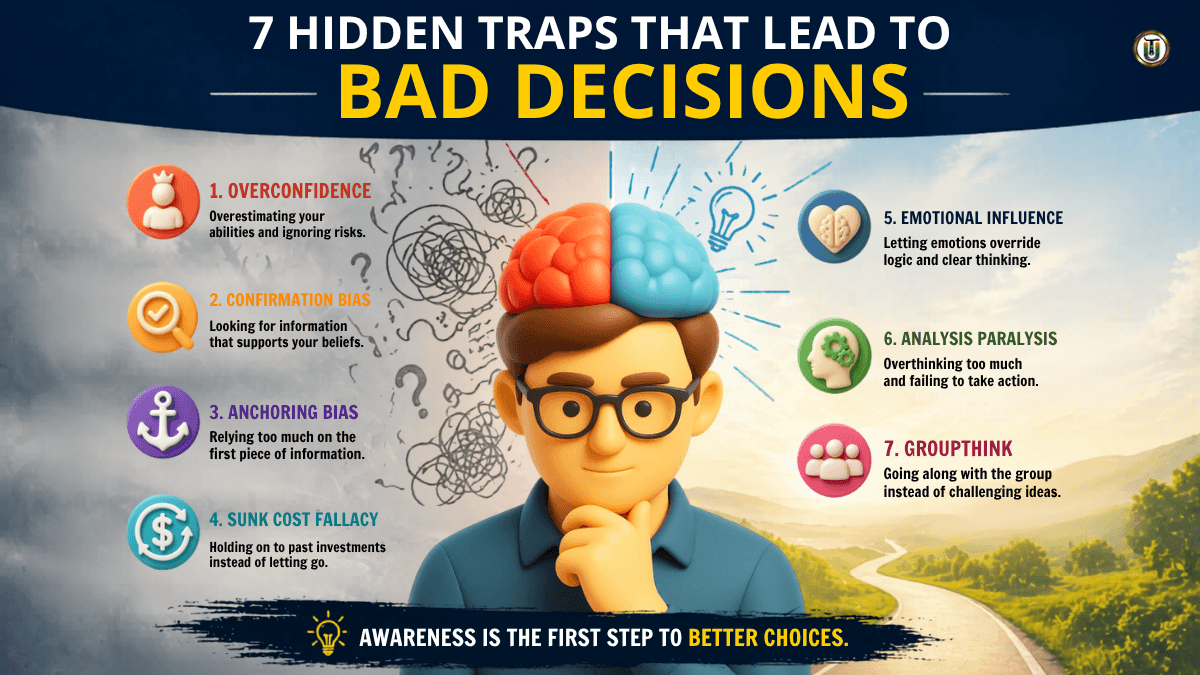
Trap 1: Overconfidence Bias
Smart people often trust their abilities too much. They rely on past success. They believe they will make the right choice again. This creates blind spots. Important risks are ignored. Overconfidence leads to quick but risky decisions.
How to overcome: Use a pre-check method. Assume failure first. List why it happened. Adjust plans. This curbs blind faith.
Trap 2: Confirmation Bias
People prefer information that supports their beliefs. Smart individuals are skilled at defending their ideas. They find strong arguments for what they already believe. e.g. A doctor spots symptoms. Assumes rare disease. Ignores basics like flu. Patient suffers longer.
This bias warps views. Intelligent minds build strong cases for wrong ideas. They dismiss doubts. Decision psychology calls it mental filtering.
How to overcome: Actively search for opposing opinions. Ask questions that challenge your thinking.
Trap 3: Anchoring Bias– Stuck on First Impressions
First information strongly influences decisions. A number, idea, or opinion becomes the base point. Even if it is wrong, it affects judgment.
Smart people analyze deeply. But if the starting point is flawed, results suffer.
How to overcome: Review multiple sources. Avoid relying on the first piece of information.
Trap 4: Sunk Cost Fallacy – Throwing Good Money After Bad
People struggle to leave something after investing time or money. Smart individuals feel the need to justify past effort. They continue even when the situation is failing. This leads to bigger losses.
How to overcome: Focus on the present value. Ignore past investment when making new decisions.
Trap 5: Emotional Influence – Heart Over Head
Emotions affect every decision. Stress, fear, or excitement can distort thinking. Even logical individuals are not immune. Quick emotional reactions lead to poor outcomes.
Bright brains process fast. Emotions derail faster. One study: Stressed smarties pick worse options 40% more.
How to overcome: Pause before deciding. Give time for emotions to settle.
Trap 6: Analysis Paralysis – Too Much Thinking
Too much thinking can block action. Over-analysis kills action. Wise people strive for perfection. Incomplete efforts are better than doing nothing.
How to overcome: Set time limits. Choose a practical option instead of a perfect one.
Trap 7: Groupthink – Echo Chambers for Elites
mart individuals often work in teams. In such groups, people avoid disagreement. They support common opinions to maintain harmony. This reduces critical thinking. Wrong ideas go unchallenged.
Why smart people make bad decisions in packs? Harmony trumps truth.
How to overcome: Encourage open discussion. Invite different viewpoints.
These traps explain smart failures. From boardrooms to bedrooms. Awareness flips the script. Next time, spot them early.
Common Patterns Behind Decision Errors
Certain patterns repeat in poor choices:
Ignoring risks
Trusting logic without emotional balance
Following others without question
Overloading with information
Avoiding feedback
These patterns affect even highly intelligent people.
How to Improve Decision-Making
Build Awareness
Recognize common biases. Awareness reduces their impact.
Seek Diverse Opinions
Different perspectives improve clarity. They reduce blind spots.
Simplify Choices
Focus on key factors only. Avoid unnecessary complexity.
Use Clear Criteria
Define goals before deciding. This creates consistency.
Balance Logic and Emotion
Use both reasoning and intuition. This improves judgment.
Accept Mistakes
Mistakes help learning. Avoid defending wrong decisions.
Use Structured Methods
Simple tools can help:
Pros and cons list
Risk analysis
Decision checklists
These methods improve clarity.
Conclusion
Smart people make bad decisions due to hidden mental traps. Biases, emotions, and habits influence judgment. Understanding these factors is essential. Better decisions come from awareness and discipline. Not just intelligence. Improving decision-making is possible. It requires practice and careful thinking.
FAQ (Frequently Asked Questions About Why Smart People Make Bad Decisions)
Why Smart People Make Bad Decisions?
Because decisions are influenced by biases and emotions, not just intelligence.
What are cognitive biases in decisions?
They are mental shortcuts that simplify thinking but can lead to errors.
Is overconfidence common in intelligent people?
Yes, they often trust their abilities too much.
What is confirmation bias?
It is the tendency to support existing beliefs and ignore opposing views.
How does emotion affect decisions?
Emotions can distort judgment and cause impulsive choices.
What is analysis paralysis?
It is overthinking that delays or prevents decisions.
Can decision-making improve with practice?
Yes, awareness and structured methods help improve decisions.
What is sunk cost fallacy?
Continuing a decision due to past investment instead of current value.
How can groupthink be avoided?
By encouraging open discussion and different opinions.
Are simple decisions better than complex ones?
In many cases, simple decisions are more effective.
Why Intelligence Is Not Enough
Intelligence helps in analysis. But decisions require more than analysis. They require awareness, control, and experience. Smart people often rely too much on thinking. They ignore emotional and psychological factors. This creates imbalance.
How can I suggest/provide feedback on this article?
You can reach us by filling out our contact us form.
Sources and References
https://www.apa.org/monitor/nov01/biases
https://hbr.org/2006/01/deciding-how-to-decide
https://www.psychologytoday.com/us/basics/decision-making
https://www.sciencedirect.com/topics/psychology/decision-making
https://www.ncbi.nlm.nih.gov/pmc/articles/PMC5741780/