
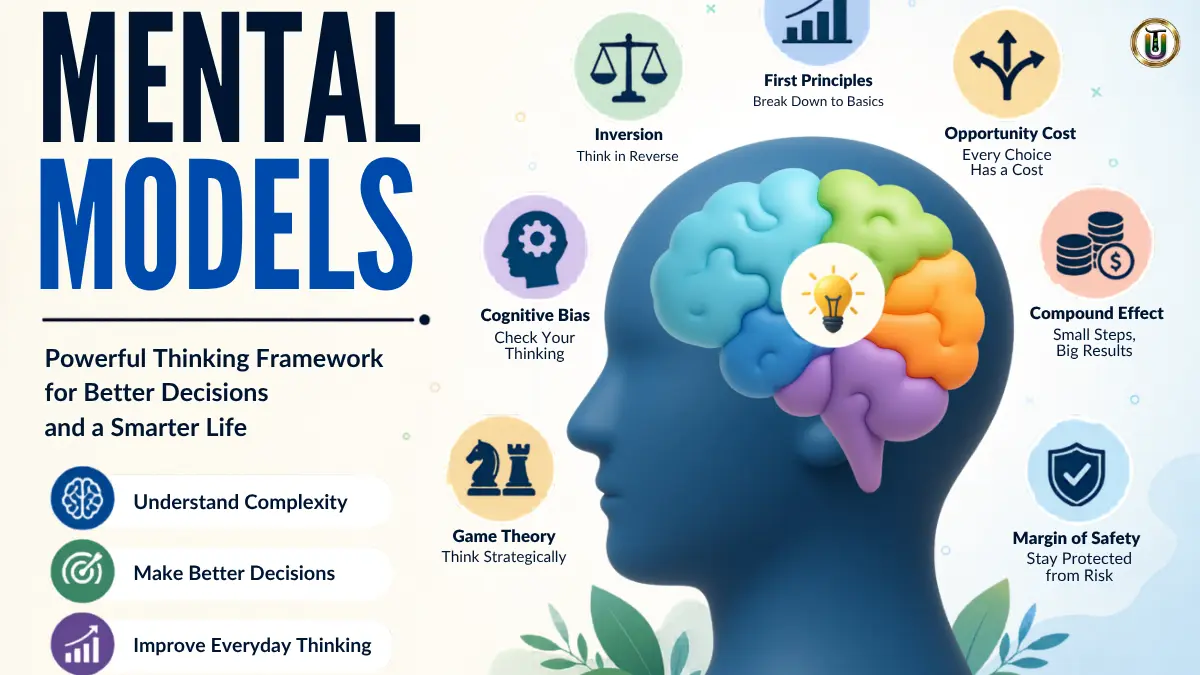
Mental models are powerful tools for thinking. They help simplify complex situations. They guide decisions and improve clarity. In the field of mind hacks, mental models play a central role. They allow structured thinking instead of random judgment.
Understanding mental model meaning and learning how to apply them can transform how decisions are made in daily life and business.
What is a Mental Model and its meaning?
Mental model meaning refers to a simplified representation of how something works. It is like a mental map. It helps in understanding reality without analyzing every detail.
Mental Model Definition
A mental model definition can be stated as:
A framework or concept that people use to interpret information, solve problems, and make decisions.
To define mental model simply:
It is a thinking shortcut based on logic, experience, or knowledge.
Mental models reduce confusion. They allow faster and better decisions.
Why Mental Models Matter
Mental models improve thinking quality. They reduce errors and bias. They help in:
Better decision making
Clear problem solving
Understanding complex systems
Avoiding common thinking mistakes
Without mental models, thinking becomes reactive. With them, thinking becomes structured and logical.
The Great Mental Models
The concept of the great mental models refers to widely accepted thinking frameworks used across disciplines. These models come from science, economics, psychology, and mathematics.
Some important examples include:
First Principles Thinking
Break problems into basic elements. Build solutions from scratch.
Opportunity Cost
Every choice has a cost. Choosing one option means losing another.
Inversion
Think in reverse. Think about how to fail and avoid it instead of thinking how to get success.
Compound Effect
Repeated Small actions can give you big results over the time.
Probabilistic Thinking
Evaluate decisions based on likelihood, not certainty.
These are called the great mental models because they apply in many areas of life.
Charlie Munger Mental Models
Charlie Munger mental models are widely respected in decision-making psychology. He emphasized using multiple models instead of relying on one idea.
His approach is called a “latticework of mental models”.
Key Ideas from Charlie Munger Mental Models
Use models from different fields
Avoid narrow thinking
Combine logic with practical wisdom
Focus on simplicity
Some commonly discussed Charlie Munger mental models include:
Margin of safety
Incentives drive behavior
Avoid cognitive biases
Circle of competence
His philosophy shows that no single model is enough. Multiple models create better understanding.
Types of Mental Models
Mental models exist in different categories. Each serves a specific purpose.
Scientific Models
These explain natural systems.
Example: Cause and effect.
Economic Models
These focus on trade-offs and value.
Example: Supply and demand.
Psychological Models
These explain human behavior.
Example: Cognitive bias.
Strategic Models
These guide planning and decision making.
Example: Game theory.
Using different types improves thinking depth.
How to Use Mental Models in Daily Life
Applying mental models is simple but requires practice.
Step 1: Identify the Problem
Clearly define the issue.
Step 2: Choose the Right Model
Select a model that fits the situation.
Step 3: Analyze the Situation
Use the model to break down the problem.
Step 4: Make a Decision
Take action based on logical evaluation.
Step 5: Review Outcome
Learn from results and improve thinking.
This process turns theory into practical use.
Common Mistakes While Using Mental Models
Even useful tools can be misused.
Overusing One Model
Relying on a single framework limits thinking.
Ignoring Context
Not every model fits every situation.
Misunderstanding Concepts
Wrong interpretation leads to wrong decisions.
Lack of Practice
Mental models improve with consistent use.
Avoiding these mistakes ensures better results.
Mental Models and Mind Hacks
Mental models are essential mind hacks. They improve thinking speed and accuracy.
They help in:
Reducing mental overload
Improving focus
Enhancing logical reasoning
Avoiding emotional decisions
They act as shortcuts but are based on logic, not guesswork.
Benefits of Using Mental Models
Using mental models provides long-term advantages:
Better clarity in thinking
Faster problem solving
Improved decision quality
Reduced cognitive bias
Strong analytical skills
These benefits make mental models essential for personal and professional growth.
How to Build Your Own Mental Models
Creating a personal set of mental models is valuable.
Learn from Different Fields
Study science, economics, psychology, and history.
Observe Patterns
Identify repeated behaviors and outcomes.
Simplify Complex Ideas
Turn detailed concepts into simple frameworks.
Practice Regularly
Apply models in real-life situations.
Reflect and Improve
Analyze outcomes and refine thinking. Over time, this builds a strong thinking system.
Conclusion
Mental models are powerful thinking tools. They simplify complexity and improve decision making. Understanding mental model meaning and applying the right frameworks can transform thinking ability.
The great mental models provide universal insights. Charlie Munger mental models highlight the importance of using multiple perspectives.
By learning to define mental model clearly and applying it in daily life, individuals can make better decisions, avoid errors, and think more effectively.
FAQ:- Frequently Asked Questions About Mental models
What is the meaning of mental models?
Mental model meaning refers to a simplified framework used to understand and interpret the world.
How do you define mental model?
To define mental model, it is a structured way of thinking that helps in decision making and problem solving.
What are the great mental models?
The great mental models are widely used thinking frameworks like inversion, opportunity cost, and first principles.
What are Charlie Munger mental models?
Charlie Munger mental models focus on using multiple disciplines to improve thinking and decision making.
Why are mental models important?
They improve clarity, reduce errors, and enhance logical thinking.
How can I suggest/provide feedback on this article?
You can reach us by filling out our contact us form.
Sources and References
Farnam Street – Mental Models Guide
Shane Parrish – The Great Mental Models Overview
Investopedia – Mental Model Definition
Harvard Business Review – Decision Making and Thinking Models
Poor Charlie’s Almanack Summary Insights