What Is Confirmation Bias? (Meaning and Definition)
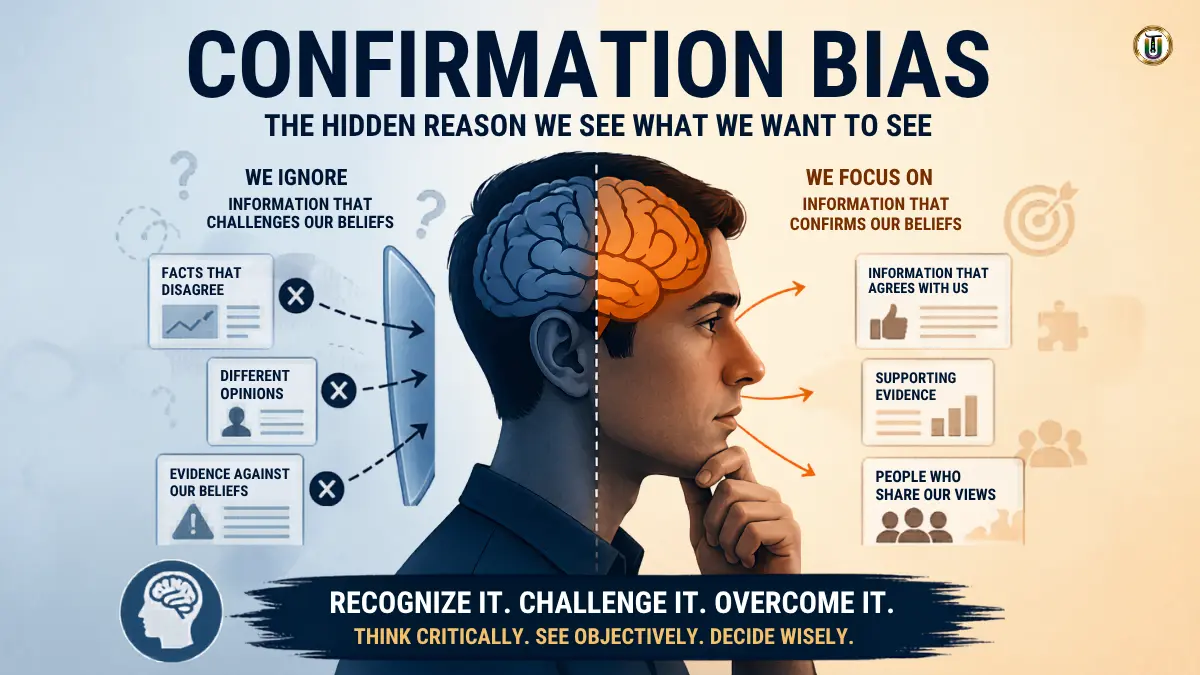
Confirmation bias is a mental tendency where individuals prefer information that supports their existing beliefs. At the same time, they ignore or reject information that challenges those beliefs.
In simple terms, confirmation bias meaning refers to “seeing what one wants to see.”
The confirmation bias definition in psychology is clear:
It is a cognitive pattern in which people selectively collect, interpret, and recall information in a way that confirms their preconceptions.
This behavior is part of confirmation psychology, a field that studies how human thinking is influenced by internal beliefs rather than objective facts.
Why Confirmation Bias Happens
Human brains are designed to save effort. Evaluating every piece of information objectively requires time and energy.
Key reasons include:
Mental efficiency: It is easier to agree than to analyze deeply.
Emotional comfort: People feel safe when their beliefs are validated.
Social identity: Beliefs often align with groups, making change difficult.
Fear of being wrong: Accepting opposing views may challenge self-image.
Because of these reasons, people become biased without realizing it.
Real-Life Examples
Understanding real situations helps clarify the concept.
A person believes a diet works. They only notice success stories and ignore failures.
An investor trusts a company. They focus only on positive news about it.
A student thinks they are weak in math. They remember failures but forget improvements.
In all these cases, individuals filter reality to match their beliefs.
How it Affects Decisions
Confirmation bias has a strong impact on everyday life.
Poor Decision-Making
When only selective information is considered, decisions become weak.
Reinforced Misbeliefs
False beliefs become stronger over time because they are never challenged.
Reduced Critical Thinking
People stop analyzing objectively and rely on assumptions.
Relationship Conflicts
Misunderstandings increase when individuals only see their own perspective.
Workplace Errors
Teams may ignore risks if they only focus on positive outcomes.
Types of Confirmation Bias
There are several types of confirmation bias. Each type shows how people process information in a limited way.
Selective Exposure
People choose information sources that match their beliefs.
Example: Reading only news that aligns with personal views.
Selective Interpretation
Information is interpreted in a way that supports existing ideas.
Example: Two people reading the same report but reaching different conclusions.
Selective Memory
People remember details that confirm their beliefs and forget others.
Example: Remembering success more than failure.
Biased Assimilation
New information is adjusted to fit old beliefs, even if it contradicts them.
Attitude Polarization
When exposed to mixed evidence, individuals become more extreme in their original beliefs.
Confirmation Trap in Research
Researchers may unintentionally focus on data that supports their hypothesis.
Social Bias
Beliefs are strengthened through group validation, even without factual proof.
Confirmation Bias in Psychology
This bias is considered a major barrier to rational thinking.
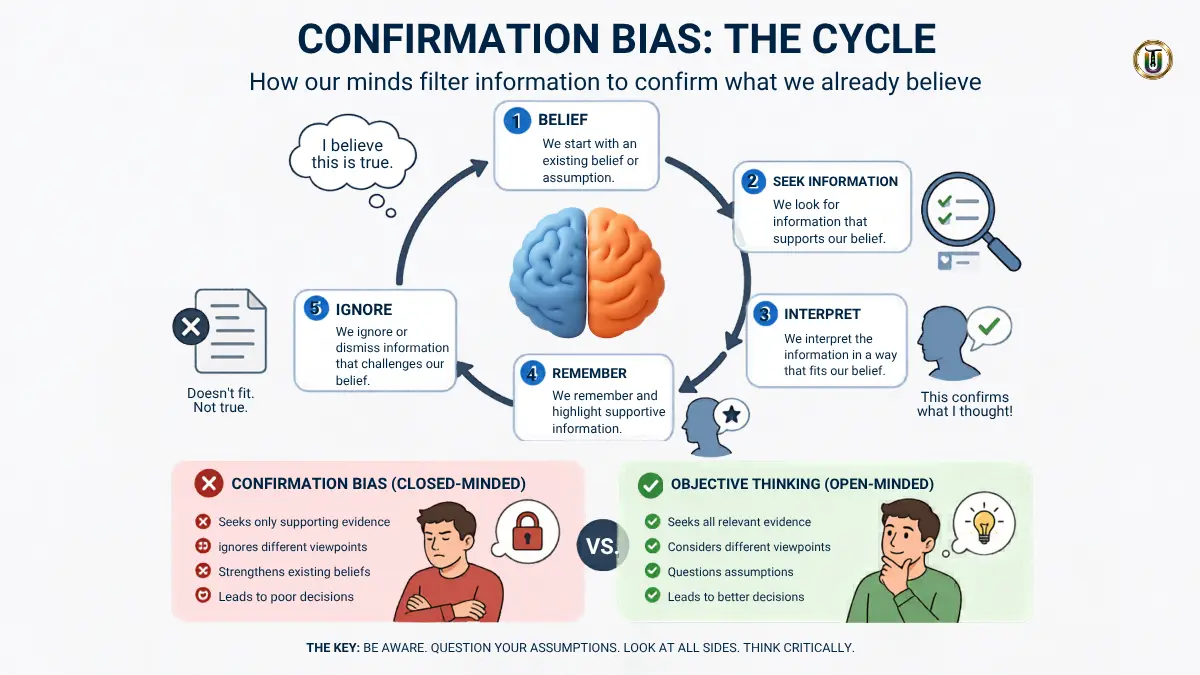
Psychologists explain that this bias operates at three stages:
Information Gathering – Choosing supportive sources
Information Interpretation – Understanding data in a biased way
Memory Recall – Remembering confirming evidence
This cycle creates a loop that strengthens beliefs continuously.
Impact on Mental Models and Thinking
It directly affects mental models.
Mental models are frameworks used to understand the world.
When bias enters these models:
Thinking becomes narrow
Learning slows down
Errors repeat over time
Thus, reducing this bias improves overall intelligence and judgment.
How to Identify Confirmation Bias
Recognizing this bias is the first step to controlling it.
Common signs include:
Ignoring opposing viewpoints
Feeling defensive when challenged
Searching only for supporting evidence
Overconfidence in personal beliefs
How to Overcome Confirmation Bias
Eliminating bias completely is difficult. However, it can be reduced with conscious effort.
Seek Opposite Views
Actively explore information that challenges your beliefs.
Ask Critical Questions
Instead of asking “Is this true?”, ask “What if this is false?”
Use Data Over Opinion
Rely on facts, research, and evidence.
Slow Down Thinking
Avoid quick decisions. Take time to analyze.
Encourage Feedback
Listen to others, especially those with different opinions.
Practice Self-Awareness
Recognize emotional reactions when beliefs are challenged.
Use Structured Decision-Making
Follow logical steps instead of intuition alone.
Why Understanding of this bias Bias Matters
To understand this bias is essential for:
Better decision-making
Stronger critical thinking
Improved relationships
Accurate knowledge building
It also helps in professional areas like business, research, and leadership.
Conclusion
It is a powerful but hidden mental error. It affects how people think, decide, and interact. Its meaning is simple, but its impact is deep.
By understanding this, recognizing its types, and applying corrective strategies, individuals can make smarter and more balanced decisions.
Reducing bias does not mean changing beliefs constantly.
It means ensuring that beliefs are based on reality, not selective thinking.
FAQ
What is confirmation bias in simple words?
It is the tendency to favor information that supports existing beliefs.
What is the confirmation bias definition in psychology?
It is a cognitive bias where individuals interpret and recall information to confirm their pre-existing beliefs.
What are the main types of confirmation bias?
Selective exposure, selective interpretation, selective memory, biased assimilation, and attitude polarization.
Why do people become biased?
Due to mental shortcuts, emotional comfort, and social influence.
Can confirmation bias be avoided?
It cannot be fully avoided but can be reduced through awareness and critical thinking.
How can I suggest/provide feedback on this article?
You can reach us by filling out our contact us form.
Sources and References
American Psychological Association
Britannica
Verywell Mind
Simply Psychology
Stanford Encyclopedia of Philosophy – Cognitive Bias