
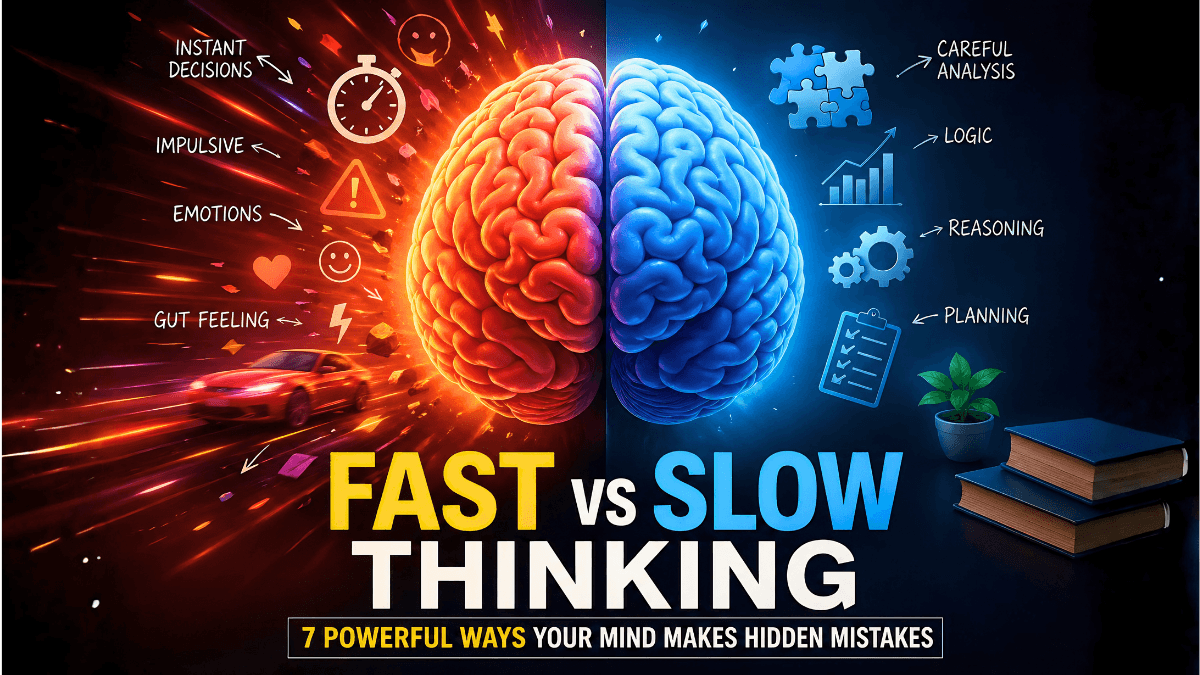
Fast vs Slow Thinking in Everyday Life
In everyday life, people make thousands of decisions. Some are quick and automatic. Others require careful thought and analysis. Understanding how these decisions are made is essential for improving judgment and avoiding costly errors.
At Universal Thrill, where curiosity meets clarity, exploring how the human mind works helps individuals make better and more informed choices.
This article explains the concept of fast vs slow thinking, how both systems work, and how they influence real-life decisions.
- Fast vs Slow Thinking in Everyday Life
- What Is Fast vs Slow Thinking?
- Key Differences Between Fast and Slow Thinking
- Why Fast Thinking Can Lead to Mistakes
- Why Slow Thinking Is Not Always Used
- Real-Life Examples of Fast vs Slow Thinking
- How to Balance Fast and Slow Thinking
- When to Use Fast Thinking vs Slow Thinking
- Psychological Importance of Fast vs Slow Thinking
- Conclusion
- FAQ Section
- Sources and References
What Is Fast vs Slow Thinking?
The idea of fast vs slow thinking comes from decision-making psychology. It explains that the brain uses two different systems:
1. Fast Thinking (System 1)
Fast thinking is:
- Automatic
- Quick
- Emotional
- Effortless
It works without conscious effort. This system helps in making rapid decisions.
Examples:
- Recognizing a familiar face
- Answering simple questions
- Reacting to danger instantly
Fast thinking is useful in situations where speed matters.
2. Slow Thinking (System 2)
Slow thinking is:
- Deliberate
- Logical
- Analytical
- Effortful
It requires focus and mental energy.
Examples:
- Solving a math problem
- Making financial decisions
- Evaluating risks
Slow thinking is important when accuracy is more important than speed.
Key Differences Between Fast and Slow Thinking
| Aspect | Fast Thinking | Slow Thinking |
|---|---|---|
| Speed | Immediate | Gradual |
| Effort | Low | High |
| Control | Automatic | Conscious |
| Accuracy | Often biased | More reliable |
| Emotion | Emotional | Logical |
Both systems work together, but they serve different purposes.
Why Fast Thinking Can Lead to Mistakes
Fast thinking is efficient, but it is not always accurate. It relies on mental shortcuts, also known as heuristics.
These shortcuts can lead to cognitive biases.
Common Issues:
- Jumping to conclusions
- Overconfidence
- Misjudging probabilities
For example, people may trust first impressions without verifying facts.
Why Slow Thinking Is Not Always Used
Although slow thinking is more accurate, people do not always use it.
Reasons:
- It requires effort
- It takes time
- The brain prefers energy-saving processes
As a result, individuals often rely on fast thinking, even in complex situations.
Real-Life Examples of Fast vs Slow Thinking
1. Shopping Decisions
Fast thinking:
- Buying impulsively due to discounts
Slow thinking:
- Comparing prices and evaluating need
2. Social Judgments
Fast thinking:
- Forming opinions based on appearance
Slow thinking:
- Understanding personality through interaction
3. Financial Decisions
Fast thinking:
- Investing based on trends
Slow thinking:
- Analyzing risks and long-term benefits
4. Driving
Fast thinking:
- Immediate reaction to avoid accidents
Slow thinking:
- Planning routes and fuel efficiency
How to Balance Fast and Slow Thinking
Improving decision-making requires balancing both systems.
1. Pause Before Important Decisions
Take time before making major choices.
2. Question First Impressions
Avoid trusting initial judgments without evidence.
3. Use Data and Logic
Rely on facts rather than assumptions.
4. Practice Critical Thinking
Analyze situations from multiple perspectives.
5. Reduce Cognitive Load
Avoid making decisions when tired or stressed.
When to Use Fast Thinking vs Slow Thinking
Use Fast Thinking When:
- Time is limited
- The situation is familiar
- Immediate action is needed
Use Slow Thinking When:
- The decision has long-term impact
- Risks are involved
- Information needs analysis
Psychological Importance of Fast vs Slow Thinking
Understanding these systems helps in:
- Reducing cognitive biases
- Improving judgment
- Making rational decisions
- Enhancing self-awareness
It also plays a key role in behavioral economics and human psychology.
Conclusion
Fast and slow thinking are both essential parts of human cognition. Fast thinking allows quick reactions, while slow thinking ensures accuracy and logical reasoning.
The key is not to eliminate one system, but to use both effectively based on the situation.
At Universal Thrill, the goal is to simplify complex psychological concepts and provide clarity that improves everyday decision-making.
FAQ Section
What is fast vs slow thinking?
Fast vs slow thinking refers to two systems of the brain—one quick and intuitive, the other slow and analytical.
Why is fast thinking prone to errors?
Because it relies on mental shortcuts and emotions, which can lead to biases.
When should slow thinking be used?
Slow thinking should be used in complex decisions that require careful analysis.
Can fast thinking be improved?
Yes, by becoming aware of biases and questioning assumptions.
Who introduced fast vs slow thinking?
The concept was popularized by Daniel Kahneman.
How can I suggest/provide feedback on this article?
You can reach us by filling out our contact us form.