
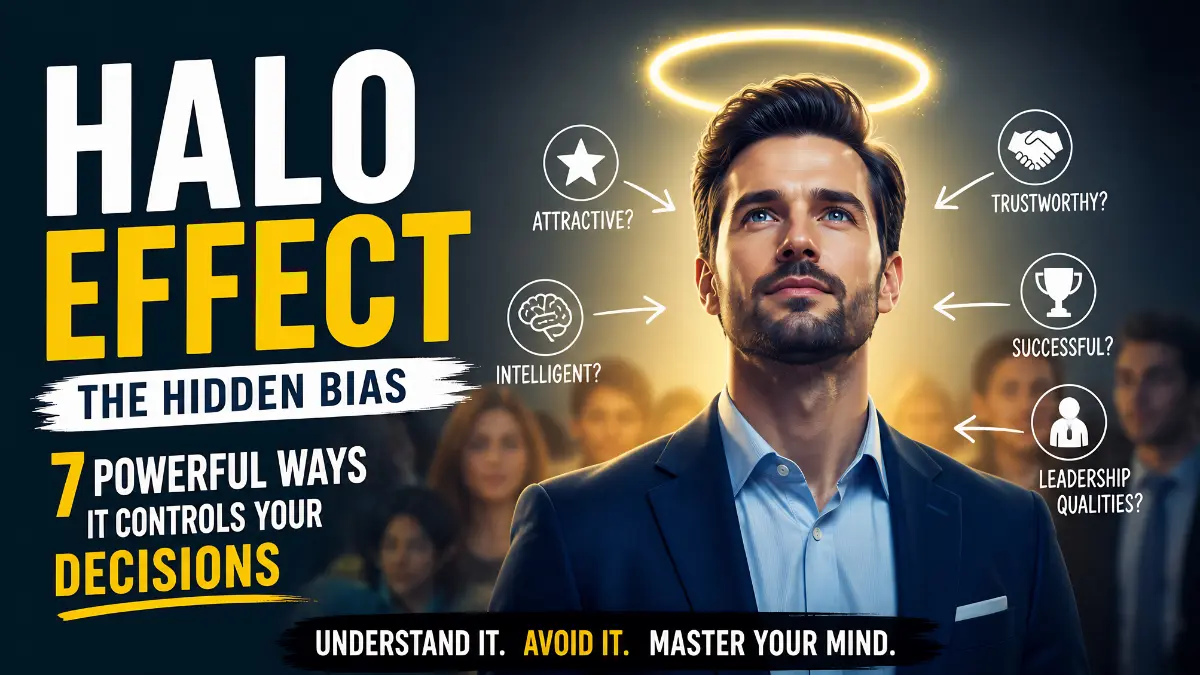
Have you ever judged someone as intelligent just because they look confident? Or assumed a product is high quality simply because of its branding?
This is not random. It is the Halo Effect—a powerful psychological bias that shapes how we perceive people, products, and situations.
At Universal Thrill, where curiosity meets clarity, understanding such mental shortcuts is essential for making smarter decisions.
- What is the Halo Effect?
- The Psychology Behind the Halo Effect
- 7 Powerful Ways the Halo Effect Influences Your Life
- Real-Life Example of the Halo Effect
- Halo Effect vs Horn Effect
- Why the Halo Effect is Dangerous
- How to Avoid the Halo Effect
- How Businesses Use the Halo Effect Strategically
- Scientific Insight
- Conclusion
- FAQ Section
- Sources & References
What is the Halo Effect?
The Halo Effect is a cognitive bias in which our overall impression of a person or thing influences how we feel and think about their character.
Simple Definition:
If one trait is positive, we assume other traits are also positive.
For example:
- Attractive person → assumed intelligent
- Famous brand → assumed high quality
This happens automatically and often without conscious awareness.
The Psychology Behind the Halo Effect
It was first identified by psychologist Edward Thorndike in 1920.
He observed that military officers rated soldiers similarly across unrelated traits. If a soldier looked strong, they were also rated as disciplined and intelligent.
Why Does This Happen?
The brain prefers shortcuts. Instead of analyzing every detail, it creates a mental shortcut (heuristic) to save time.
This leads to:
- Faster decisions
- Reduced mental effort
- But increased errors in judgment
7 Powerful Ways the Halo Effect Influences Your Life
1. First Impressions Dominate Everything
Your first interaction with someone heavily shapes your long-term perception.
Even small cues like:
- Dressing style
- Body language
- Tone of voice
can influence judgments for a long time.
2. Attractiveness Bias
People who look good are often perceived as:
- More intelligent
- More trustworthy
- More capable
This is why attractive individuals often receive better opportunities.
3. Brand Perception
Well-known brands benefit from the Halo Effect.
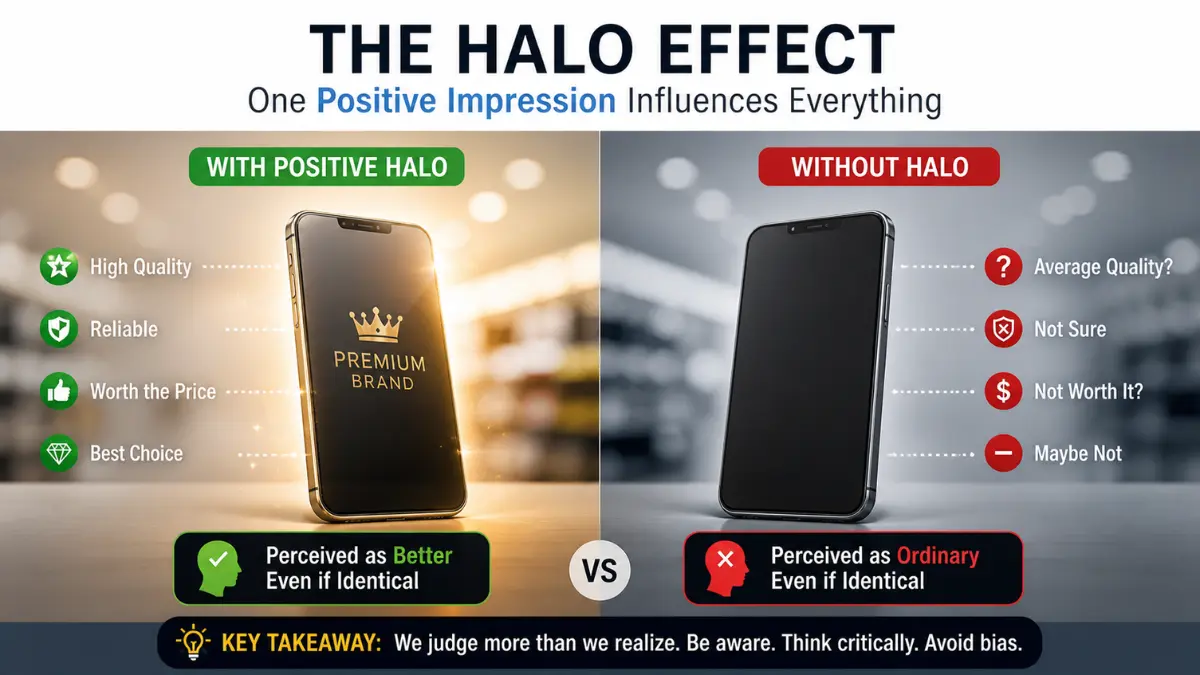
If a company is known for one great product, customers assume all their products are high quality.
4. Workplace Evaluations
Managers may rate employees based on one strong trait.
Example:
- A punctual employee → assumed hardworking overall
This can lead to unfair promotions or missed talent.
5. Social Media Influence
Influencers with strong personal branding are perceived as experts—even outside their actual expertise.
6. Education and Academics
Teachers may unconsciously favor students who:
- Perform well early
- Show confidence
This affects grading and attention.
7. Product Marketing
Companies use design, packaging, and endorsements to create a positive halo.
This leads consumers to:
- Trust products more
- Ignore flaws
Real-Life Example of the Halo Effect
Imagine two identical smartphones:
- One has a premium brand logo
- The other has no branding
Most people will assume the branded phone is better—even if both are identical.
This demonstrates how perception overrides reality.
Halo Effect vs Horn Effect
The opposite of the Halo Effect is the Horn Effect.
| Halo Effect | Horn Effect |
|---|---|
| One positive trait influences perception | One negative trait dominates perception |
| Leads to overestimation | Leads to underestimation |
Example:
- Well-dressed person → judged positively
- Poorly dressed person → judged negatively
Why the Halo Effect is Dangerous
While it helps in quick decisions, it can lead to serious errors.
Key Risks:
- Biased hiring decisions
- Misjudging people
- Poor investments
- Overpaying for brands
It creates an illusion of accuracy while hiding real information.
How to Avoid the Halo Effect
1. Separate Traits
Evaluate each quality independently.
Do not assume:
“Good in one area = good in all areas”
2. Use Objective Data
Rely on measurable facts instead of impressions.
3. Delay Judgments
Avoid making quick decisions based on first impressions.
4. Ask Critical Questions
Challenge your assumptions:
- Why do I think this is good?
- What evidence supports this?
5. Seek Multiple Opinions
Different perspectives reduce bias.
How Businesses Use the Halo Effect Strategically
Companies intentionally create a positive halo to influence consumers.
Common Strategies:
- Celebrity endorsements
- Premium packaging
- Strong branding
- Positive reviews
This increases trust and perceived value.
Scientific Insight
Research in behavioral psychology confirms that humans are not fully rational decision-makers.
The Halo Effect is part of a broader category called cognitive biases, which shape everyday decisions without conscious awareness.
Conclusion
The Halo Effect is a powerful mental shortcut that influences how we judge people, products, and situations.
While it helps simplify decisions, it often leads to inaccurate conclusions.
Understanding this bias allows you to:
- Make better decisions
- Avoid manipulation
- Think more critically
At Universal Thrill, the goal is to help you recognize these hidden patterns and gain clarity in your thinking.
FAQ Section
What is the halo effect in simple terms?
It is a bias where one positive trait makes us assume other positive qualities.
Is the halo effect always harmful?
Not always, but it can lead to incorrect judgments if not controlled.
What is an example of the halo effect?
Assuming a well-dressed person is more competent than others.
Who discovered the halo effect?
Psychologist Edward Thorndike in 1920.
How can I avoid the halo effect?
By evaluating facts separately, questioning assumptions, and using objective data.
How can I suggest/provide feedback on this article?
You can reach us by filling out our contact us form.
Sources & References
- Thinking, Fast and Slow – Daniel Kahneman
- Influence: The Psychology of Persuasion – Robert Cialdini
- https://www.simplypsychology.org/halo-effect.html