
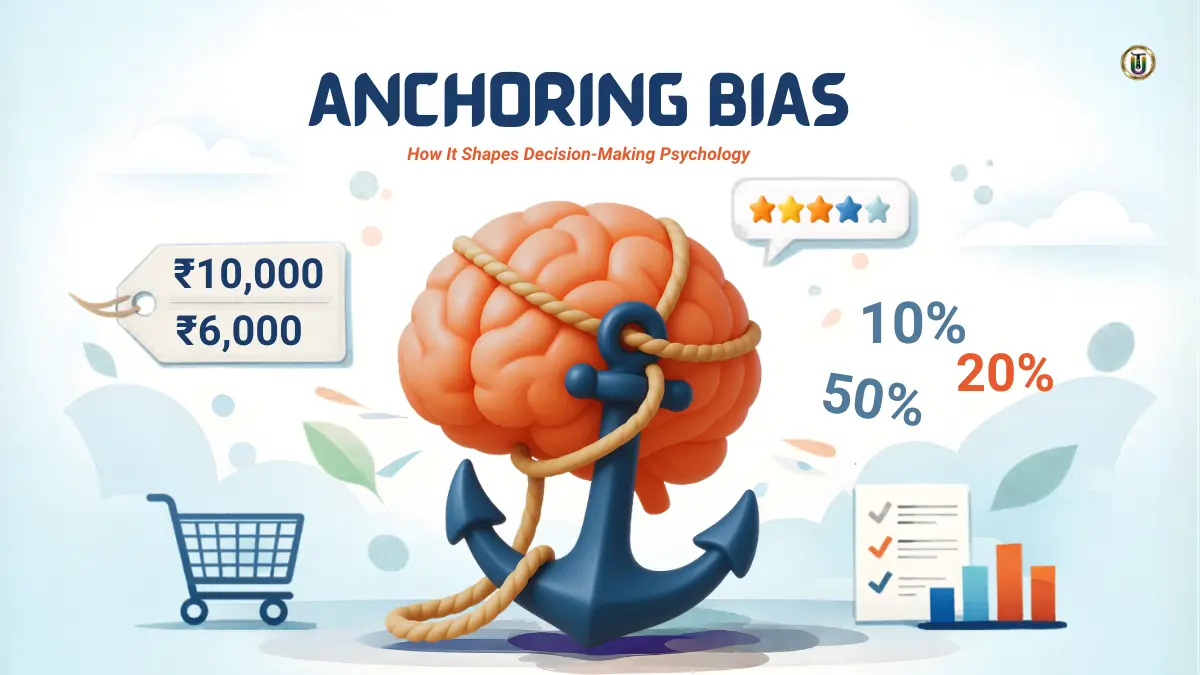
Anchoring bias is a powerful cognitive bias that shapes how people think, judge, and make decisions. It occurs when an individual relies too heavily on the first piece of information they receive. This initial information acts as a mental anchor. All subsequent judgments are made by adjusting around this anchor, often without proper evaluation.
The human brain is designed to process information quickly. To do this, it uses mental shortcuts known as heuristics. Anchoring bias is one such shortcut. It helps in making fast decisions, but it can also lead to systematic errors. Once an anchor is set, the brain tends to stick close to it, even when new information suggests otherwise.
Anchoring biases are not limited to numbers. It can be influenced by prices, opinions, visuals, or even first impressions. For example, when a person sees a high original price followed by a discount, the discounted price appears more attractive. The initial price becomes the reference point, even if it is not realistic.
This bias plays a significant role in daily life. It affects financial decisions, negotiations, shopping behavior, and professional judgments. Businesses and marketers often use anchoring strategically to influence customer perception. Similarly, individuals unknowingly apply anchoring in their personal decisions.
Research in behavioral economics and psychology shows that anchoring bias affects both novices and experts. Even when people are aware of this bias, they may still be influenced by it. This makes anchoring one of the most persistent and widely studied cognitive biases.
Understanding anchoring bias is important for improving decision-making. It helps individuals recognize how initial information can distort judgment. By becoming aware of this tendency, people can take steps to evaluate information more objectively and make more rational choices.
Example
If a product is first shown at ₹10,000 and later offered at ₹6,000, it feels like a great deal. Even if the product’s real value is ₹5,000, the initial price influences perception.
Why the Human Brain Develops Anchoring Biases?
Anchoring biases exists because the brain prefers speed over accuracy. It reduces mental effort.
Key reasons include:
Cognitive ease: The brain avoids complex calculations.
Limited information processing: Humans cannot analyze all data deeply.
First impression effect: Initial data feels more reliable.
Uncertainty reduction: Anchors provide a starting point when unsure.
From an evolutionary perspective, quick decisions helped survival. However, in modern life, this shortcut can mislead judgment.
Types of Anchoring Bias
Numeric Anchoring
This occurs when numbers influence decisions.
Example:
A seller sets a high initial price. Buyers negotiate based on that number, even if it is unrealistic.
Social Anchoring
People rely on others’ opinions as anchors.
Example:
If many people rate a product highly, new buyers assume it is good without deeper evaluation.
Visual Anchoring
Images or visual cues act as anchors.
Example:
Luxury stores use premium design and lighting to anchor perceptions of high value.
Comparative Anchoring
Decisions are made by comparing with a reference point.
Example:
A ₹50,000 phone seems expensive until compared with a ₹1,00,000 model.
Self-Generated Anchoring
Individuals create their own anchors based on past experiences.
Example:
If someone previously bought a shirt for ₹2,000, they may consider ₹1,500 cheap, regardless of actual quality.
How Anchoring Bias Affects Decision Making
Anchoring bias influences multiple areas of life:
Financial decisions: Investments based on initial price points.
Shopping behavior: Discounts appear more attractive.
Negotiations: First offer sets the tone.
Medical decisions: Initial diagnosis influences later opinions.
Business strategy: Early estimates guide future planning.
This bias can lead to systematic errors. People often fail to adjust enough from the anchor.
How to Reduce or Overcome Anchoring Bias
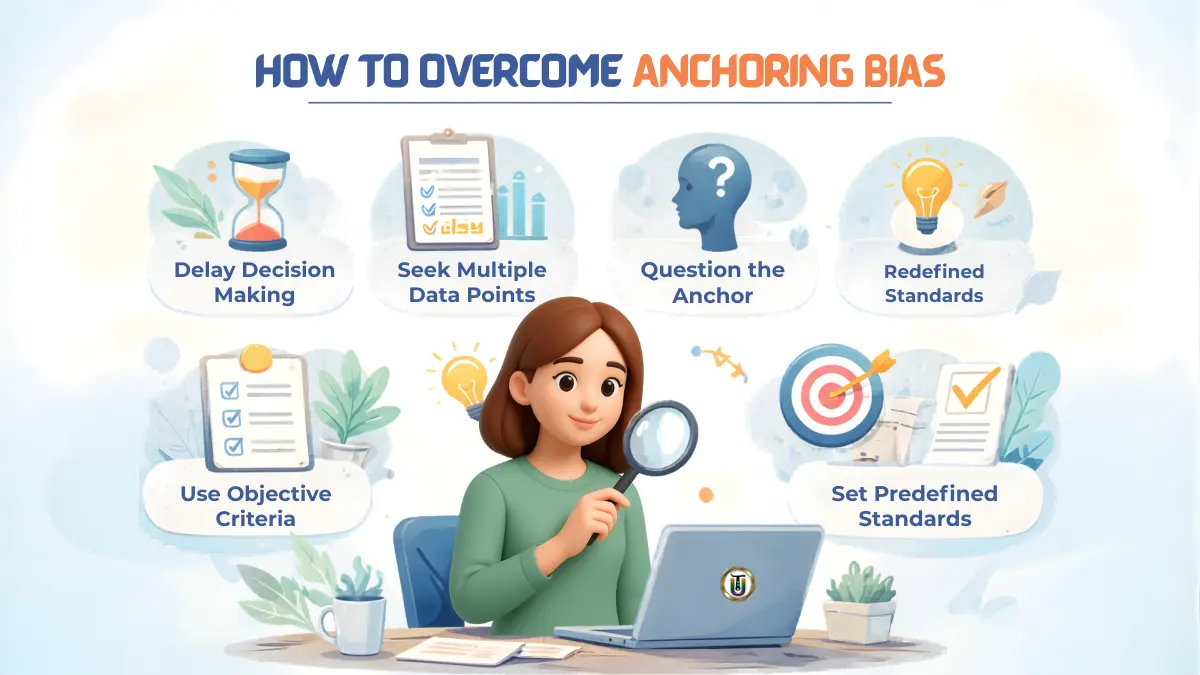
Delay Decision Making
Avoid making quick judgments. Take time to evaluate all information.
Seek Multiple Data Points
Do not rely on a single number or opinion. Compare various sources.
Question the Anchor
Ask whether the initial information is relevant or random.
Use Objective Criteria
Base decisions on facts, data, and logic rather than perception.
Practice Independent Thinking
Form your own judgment before seeing others’ opinions.
Reframe the Problem
Look at the situation from different perspectives to avoid fixation.
Set Predefined Standards
Create benchmarks in advance to reduce influence from external anchors.
Conclusion
Anchoring bias is a powerful psychological effect. It shapes decisions by relying on the first piece of information. While it simplifies thinking, it often leads to inaccurate judgments.
Understanding this bias improves awareness. With conscious effort, individuals can make more rational and informed decisions. Reducing reliance on anchors leads to better outcomes in personal, financial, and professional life.
FAQ (Frequently Asked Questions About Anchoring Effect | Decision Making Psychology)
What is anchoring bias in simple words?
It is the tendency to rely too much on the first information received when making decisions.
Is anchoring effect always harmful?
Not always. It helps in quick decisions, but it can lead to errors if not checked.
Where is anchoring effect commonly used?
It is widely used in marketing, pricing strategies, and negotiations.
Can anchoring bias affect experts?
Yes. Even experienced professionals are influenced by initial information.
How can businesses use anchoring bias ethically?
By presenting fair comparisons and transparent pricing instead of misleading anchors.
How can I suggest/provide feedback on this article?
You can reach us by filling out our contact us form.
Sources and References
https://www.investopedia.com/terms/a/anchoring.asp
https://www.simplypsychology.org/anchoring-bias.html
https://www.behavioraleconomics.com/resources/mini-encyclopedia-of-be/anchoring/
https://www.ncbi.nlm.nih.gov/pmc/articles/PMC4606844/
https://hbr.org/2015/01/what-is-anchoring